6 reasons MEP manufacturers invest in a BIM-integrated product configurator
03.11.2026
MagiCAD Group
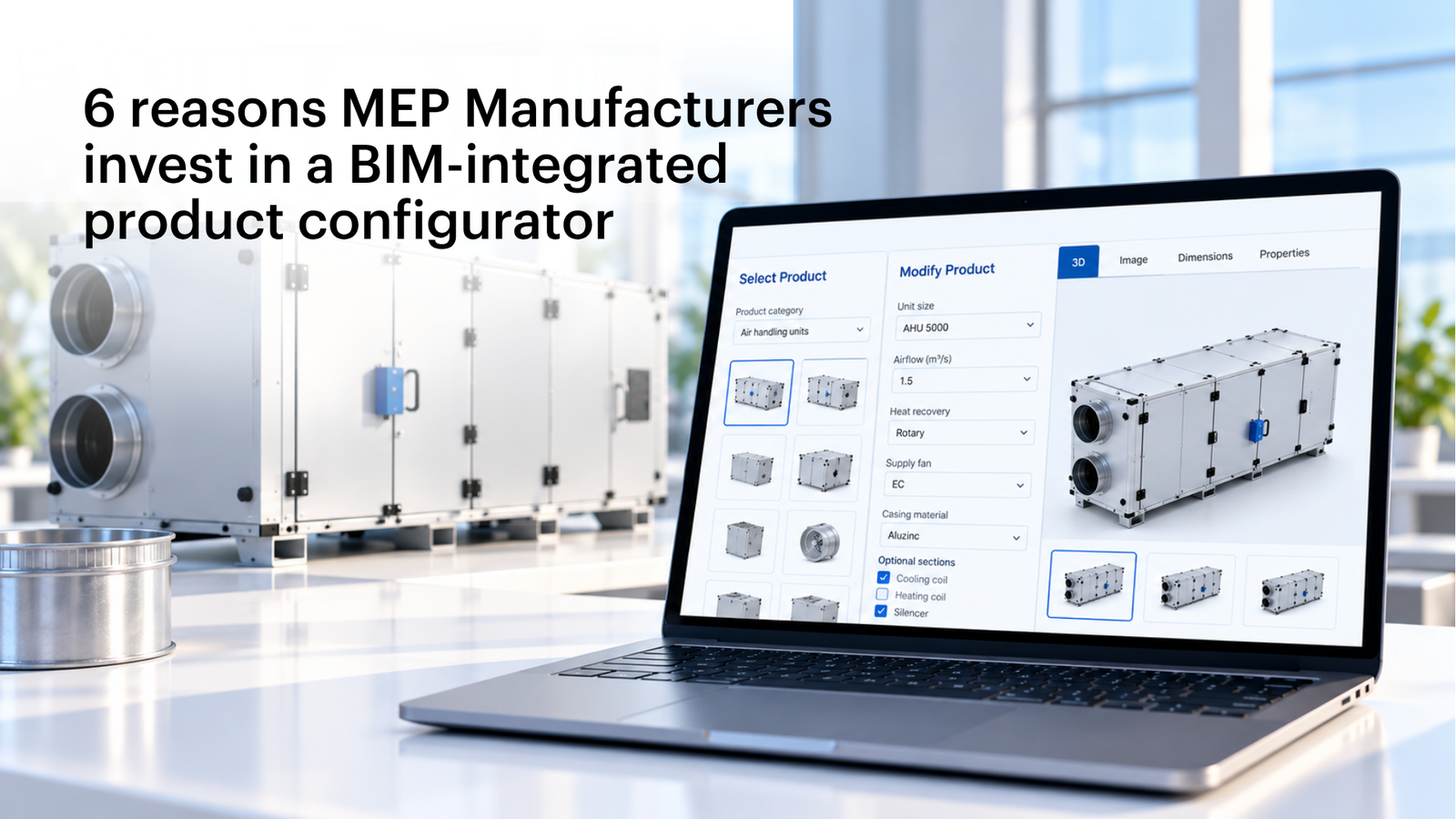
Why software development is becoming part of the product strategy for MEP manufacturers
The more configurable an MEP product becomes, the harder it can be for customers to select it.
An air handling unit, kitchen ventilation solution, drainage system or other configurable MEP product may have hundreds or thousands of possible combinations. Dimensions, performance requirements, accessories, technical rules and project conditions can all affect which configuration is suitable.
Manufacturers understand this complexity. Their customers do not necessarily have the same product expertise. This creates a digitalisation challenge: how do you turn your product knowledge into a tool that helps customers reach a technically suitable product quickly and confidently?
A product configurator can do much more than digitise a catalogue. When the configuration logic is connected to BIM and other business systems, it can become part of the manufacturer’s product, sales and customer service strategy.
Here are six reasons manufacturers choose this approach
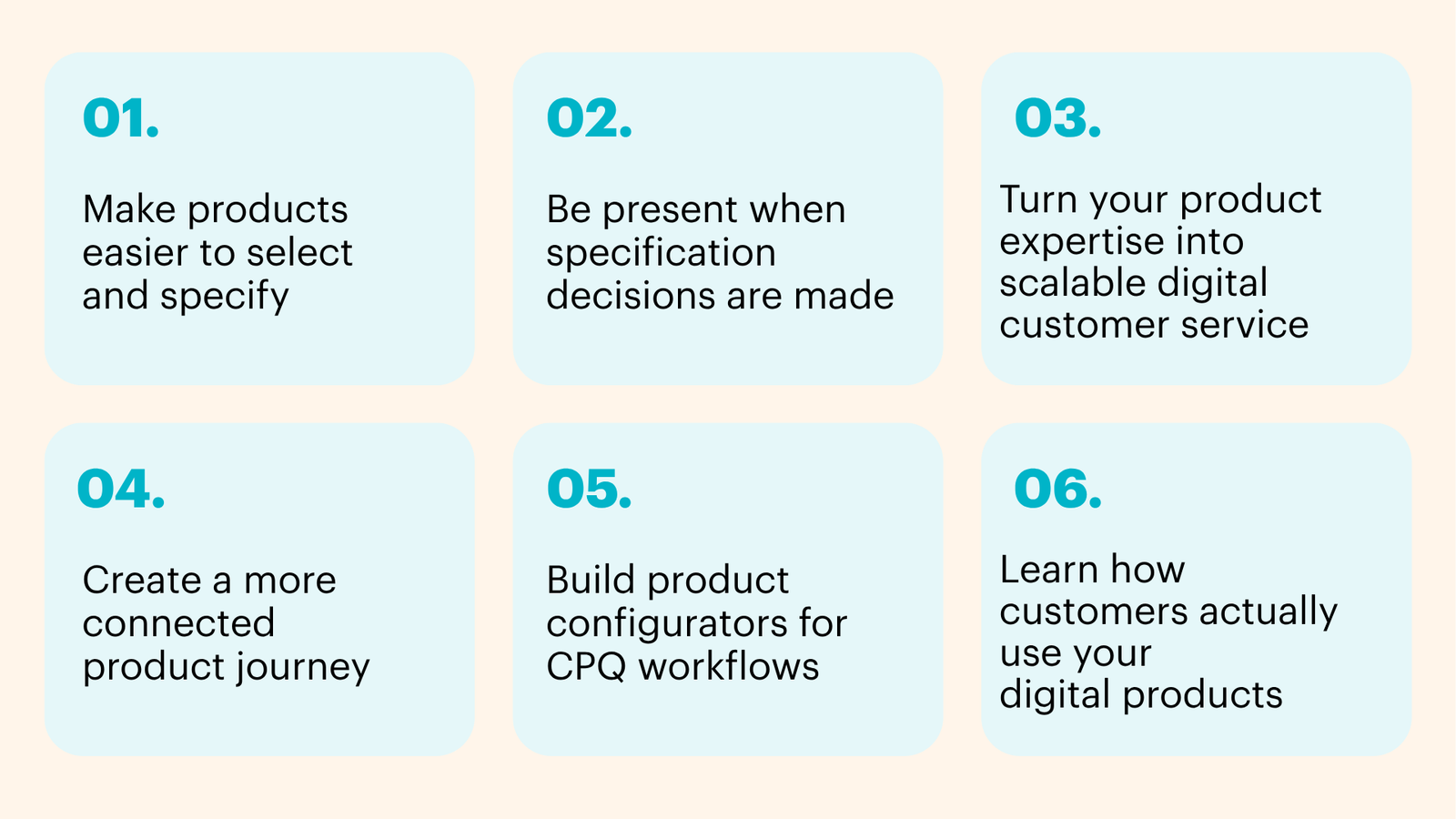
1. Make products easier to select and specify
2. Be present when specification decisions are made
3. Turn your product expertise into scalable digital customer service
4. Create a more connected product journey
5. Build product configurators for CPQ workflows
6. Learn how customers actually use your digital products
1. Make products easier to select and specify
Choosing the right product can require designers to compare variants, interpret technical documentation and check whether a product meets the requirements of the project. A conventional product catalogue often leaves much of the this work to the designers. The more information they need to interpret manually, the harder it can be to move confidently from product search to specification. A digital product configurator can turn product selection into a guided workflow.
For the manufacturer, selection tool makes products easier to sell and specify.
For the designer, it means less manual product research, fewer repetitive tasks and greater confidence that the selected configuration is technically suitable.
The business value is straightforward: the easier a product is to select correctly, the easier it is to consider for a project.
2. Be present when specification decisions are made
Product visibility is not only about being found in an online search or appearing in a digital catalogue.
For MEP manufacturers, one of the most important opportunities comes earlier in the project, when designers are defining technical requirements and deciding which products are suitable for the system.
A BIM-integrated configurator can help manufacturers become part of that decision-making process sooner.
By making manufacturer-specific products easier to evaluate and specify within the designer’s normal workflow, a BIM-integrated configurator can increase the likelihood that real products are considered while the project is still taking shape.
This can be particularly valuable when manufacturer’s product capabilities influence how the system is designed. If designers can understand available performance ranges, configurations and technical options early enough, those capabilities can help inform the requirements of the project itself.
For the manufacturer, the value is earlier visibility and a stronger opportunity to become specified before product decisions are fixed.
For the designer, the value is easier access to product-specific information at the point when design decisions are being made.
Digital product development therefore becomes part of specification strategy, not only product visibility.
3. Turn your product expertise into scalable digital customer service
Many manufacturers rely heavily on technically experienced sales engineers and product specialists. That expertise is valuable, but it can also become a bottleneck.
When every product selection requires an email, telephone call or manual calculation from an expert, the quality of the service may be excellent but difficult to scale.
A configurator provides another way to deliver that expertise.
Product rules, calculations and selection logic that previously existed in documentation, spreadsheets or in the knowledge of experienced employees can be translated into a guided digital workflow.
This does not remove the role of sales engineers or product specialists. It allows technical specialists to focus their time on more demanding cases, while customers can handle straightforward product selections independently when appropriate.
For customers, support becomes available when they need it.
For manufacturers, technical knowledge becomes a reusable digital asset rather than something that must be manually repeated for every enquiry.
4. Create a more connected product journey
Product selection often happens across several disconnected steps. Designers may start with project requirements in their design software, move to a separate catalogue or selection tool, enter technical values manually, then recreate the selected product in the BIM model. A BIM-integrated product configurator can connect more of this process.
Relevant information from the design can be used as input for product selection, helping the user start with project-specific requirements rather than from a blank screen. Once a suitable product or configuration has been identified, the result can be transferred back into the design workflow together with the relevant product information.
For the designer, this reduces repeated data entry and makes the transition from design requirements to product selection more efficient.
For the manufacturer, it creates a smoother route from product discovery to specification and makes the digital product offering more useful within the customer’s actual workflow.
The value is in continuity: project requirements inform the selection, and the selected product returns to the project ready for further design work.
5. Build product configurators for CPQ workflows
One of the strongest reasons to invest in a product configurator is that its value does not need to stop with BIM.
Configuration logic can be extended into CPQ, Configure, Price, Quote, workflows. Sales teams and distributors can use the same product rules to configure products, support pricing and produce quotation documentation. This helps create continuity between design and sales.
The approach can also be connected with manufacturer systems depending on the development need. For example, a manufacturer can connect its selection tool with its webshop so the sales team can move from product configuration towards quotations and orders within a connected workflow.
The bigger opportunity is therefore to ask: Where could the digital product logic create value in our organisation?
6. Learn how customers actually use your digital products
Traditional product documentation tells manufacturers very little about what happens after it is published. A catalogue can be downloaded. A product page can be visited. But those actions do not necessarily reveal how designers are interacting with the actual product range.
Connected digital tools create new possibilities. For example, within the MagiCAD Cloud ecosystem, manufacturers can gain insights into how designers discover, select and use their products and digital tools.
This can help answer commercially useful questions:
- Which products attract the most interest?
- Which configurations are being selected?
- In which markets are products being used?
- How are digital tools being adopted?
- Where should future development effort be focused?
- Where should future development effort be focused?
These insights can support product development, marketing, sales and the manufacturer’s wider digital strategy. A configurator therefore becomes more than a customer-facing application. It can also provide a new source of information about how the market interacts with the product portfolio.
The strongest product configurators solve a business problem, not a software problem
A manufacturer does not need a configurator simply because configurators are becoming common. There should be a clear problem worth solving.
Perhaps the product portfolio has become too complex for conventional online selection.
Perhaps engineers repeatedly contact the sales organisation with the same technical questions.
Perhaps customers can configure products on the website but cannot use those configurations efficiently in BIM.
Perhaps separate tools are used by designers, sales teams and distributors, creating duplicate work and inconsistent configurations.
Perhaps the company has strong product expertise but lacks the software resources to turn that expertise into a scalable digital service.
These are software development questions, but they are also business questions.
The right starting point is therefore not a list of software features.
It is understanding where customers and internal teams currently lose time, where product complexity creates friction and where a better digital workflow could make the manufacturer’s products easier to select, specify and sell.
Why develop an MEP product configurator with MagiCAD Group?
MagiCAD Group works on both sides of the manufacturer and designer relationship.
Our experience in MEP design software gives us insight into how engineers work with products during building design. MagiCAD Cloud extends that expertise to the digital services manufacturers provide to those designers. This matters when developing engineering software.
A successful configurator needs to understand both the manufacturer’s product and the user’s workflow.
The goal is not simply to create another software application. It is to turn manufacturer expertise into a digital service that makes complex products easier to work with.
Depending on the manufacturer’s existing digital environment and business objectives, the right solution may involve a MagiCAD Cloud Selection Tool, integration of an existing configurator through MagiCAD Cloud Plugins, CPQ capabilities or a combination of connected services.
Avoid starting every software project from zero
The software development conversation should begin with the problem you want to solve.
For many manufacturers, the case for a configurator is easy to understand. Developing and maintaining one is the more difficult question. Building specialised engineering software internally requires more than software developers.
The development team needs to understand the products, configuration logic, technical calculations, BIM workflows, user experience and the way MEP professionals actually work.
There is also an ongoing need to maintain and develop the solution as products, software environments and customer expectations change.
MagiCAD Group approaches selection tool projects from an MEP software perspective.
The tools are developed using a modular approach based on the MagiCAD Cloud Software Platform. Proven software components and existing platform capabilities can be reused instead of rebuilding every part of the application for each project.
The development work can therefore focus more closely on what is unique to the manufacturer’s products: the rules, calculations, workflows and customer experience that differentiate the solution.
For manufacturers evaluating whether to build internally or work with a software development partner is an important consideration.
The question is not only who can write the software. It is who understands the product, the MEP workflow and what the software needs to achieve for the customer. It is also who can develop the solution securely, test it properly and maintain it over time.
Generating code is only one part of software development. A reliable business application also needs sound architecture, security, quality assurance, updates and ongoing maintenance as MEP design software and BIM platforms evolve through regular releases and annual versions. This is especially important for tools that become part of a manufacturer’s customer-facing or sales-critical workflows.
Does your product portfolio need a smarter configuration workflow?

Consider how your customers select your products today.
If configuration depends heavily on manuals, spreadsheets, specialist support or disconnected digital tools, there may be an opportunity to simplify the process.
The same applies internally. If product rules are being recreated across design tools, sales systems and quotation workflows, a shared digital configuration logic may offer wider value than a standalone product selector.
MagiCAD Group develops digital tools specifically for MEP manufacturers and can help evaluate what type of solution fits your products, users and existing systems.
Talk to our team about your software development needs and explore what a product configurator could look like for your business.
MagiCAD Cloud is the leading BIM platform connecting MEP designers with manufacturers worldwide. It provides high-quality BIM objects, product configurators, and design tool integrations that bring manufacturers’ products directly into the MEP design workflow. MagiCAD Cloud helps manufacturers gain visibility in real design projects, support specification at the earliest stages, and deliver smarter, greener, and more efficient buildings.